

Keywords
expression
eroticism
Hollandism
libertinism
history painting
Italian fashion
Italian journey
genre character
ancient sculpture
the Academy Salon
Categories
How to Cite
Abstract
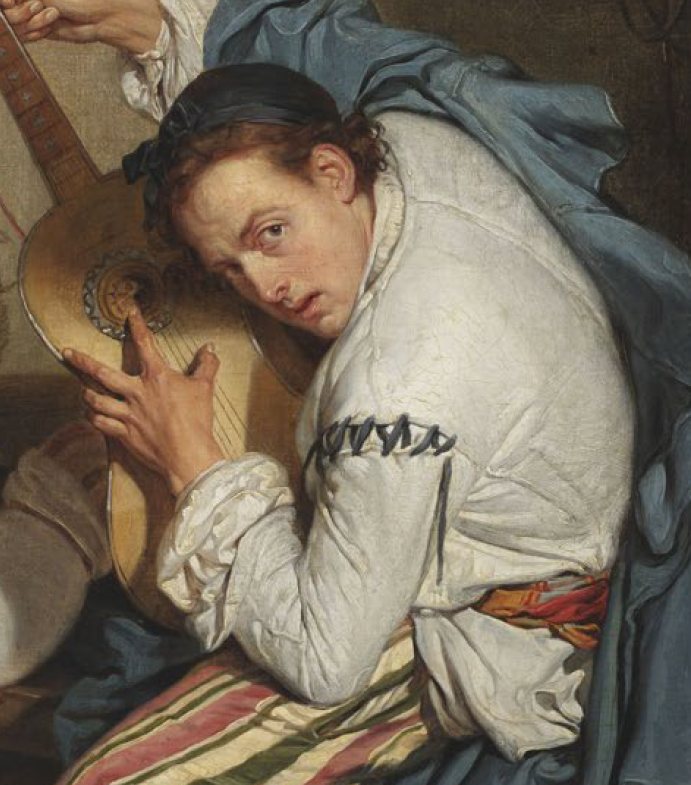
After his resounding success at the 1755 Salon in Paris, Jean-Baptiste Greuze went to Italy, where he stayed for two years. During his sojourn, he was interested in the local folklore as much as in the ancient, Renaissance and Baroque art of Italy. The most important fruit of that journey were the ‘four paintings in an Italian costume’ – Broken Eggs, The Neapolitan Gesture, Indolence and The Bird-Catcher Tuning His Guitar after the Return from a Hunt, which he exhibited at the 1757 Salon. They were admired and immediately purchased by collectors, but later fell into oblivion for a long time. They were restored to art history by Willibald Sauerländer (1965) and written about by the painter’s biographers Anita Brookner (1972) and Edgar Munhall (1976). Andrzej Pieńkos devoted a separate study to them (1987). Yet in publications on Greuze or, more broadly, on eighteenth-century French art, they are usually omitted or discussed only briefly, as a transitional episode before the famous multi-figure family scenes Greuze painted after 1760. Thanks to the publications of Antoine Chatelain (especially the diary of Louis Gougenot, Voyage dans différentes contrées de France et d’Italie [Paris, 2023], which he edited), more details about Greuze’s travels in Italy with his patron, Abbé Gougenot, came to light. In this article, the author reports on the state of research and views on the four paintings, their fortunes and their popularity, expressed, among others, by print reproductions made by the famous engraver Pierre-Étienne Moitte. This series was most often treated as a continuation of Greuze’s Dutch-style genre painting from the period of his debut in 1755, only with the figures dressed in Italian costumes, as well as a harbinger of his more important later works. However, looking at Greuze’s concept of creating a narrative in two pairs of pendants, as well as his use of a coherent mixture of different artistic patterns, the author suggests that the ‘four paintings in an Italian costume’, and to the greatest extent The Bird-Catcher from the National Museum in Warsaw, were a well-thought-out experiment in modern peinture d’histoire. The ‘pathos formula’ achieved by means of clear references to famous ancient sculptures, to a fresco by Michelangelo, and perhaps also to paintings by Caravaggio, gave an ordinary libertine tale an elevated quality expected by the Academy milieu. The contemporary Italian costume, in turn, combined with the scenery and staging of genre scenes referring to the then popular patterns of seventeenth-century Dutch art, met the tastes of the collectors with whom Greuze associated from the very beginning of his career.
References
Bailey Colin B., Jean-Baptiste Greuze: The Laundress (Los Angeles, 2000).
Barker Emma, Greuze and the Painting of Sentiment (Cambridge, 2005).
Brookner Anita, Greuze: The Rise and Fall of an 18th Century Phenomenon (London, 1972).
Chatelain Antoine, ‘Jean-Baptiste Greuze à Rome (1755–1757): quelques remarques sur son activité de dessinateur’, Les cahiers d’histoire de l’art, vol. 20 (2022), pp. 53–63.
Jean-Baptiste Greuze 1725–1805, ed. Munhall Edgar, exh. cat., Wadsworth Atheneum, Hartford, California Palace of Legion of Honor, San Francisco, Musée des Beaux-Arts, Dijon (Hartford, 1976).
Pieńkos Andrzej, ‘L’Oiseleur et les trois autres « tableaux dans le costume italien ». Quelques remarques sur l’oeuvre de jeunesse de J.-B. Greuze’, Bulletin du Musée National de Varsovie, vol. 28, no. 1–2 (1987), pp. 1–13.
Sauerländer Willibald, ‘Pathosfiguren im Oeuvre des J.B. Greuze’, in Walter Friedlaender zum 90. Geburtstag, eds Georg Kauffmann, Willibald Sauerländer (Berlin, 1965), pp. 146–150.

This work is licensed under a Creative Commons Attribution 4.0 International License.
Copyright (c) 2026 Andrzej Pieńkos