

Keywords
seventeenth-century prints
printing plates
bookplates
heraldry
painting on copper
sacral art
early modern art
Categories
How to Cite
Abstract
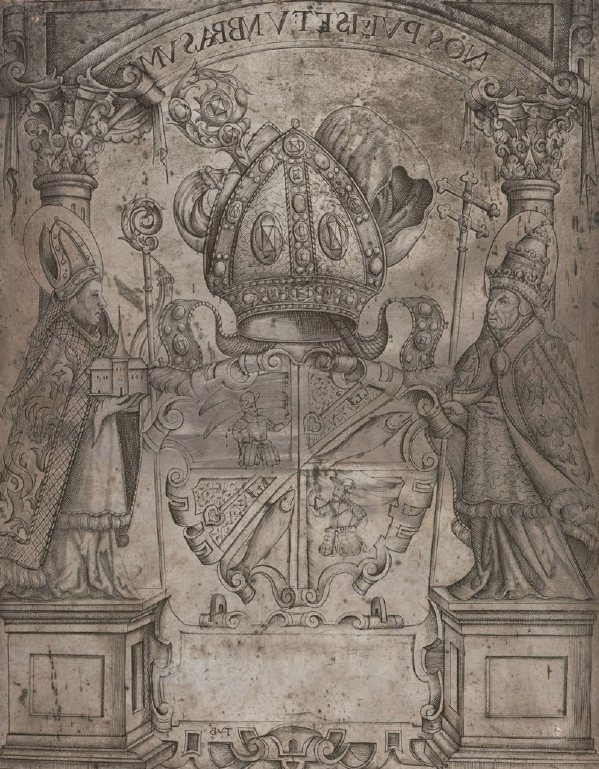
The article discusses printing plates repurposed as painting supports based on two examples from the collection of the National Museum in Warsaw. The first copper plate, engraved by the Monogrammist T.V.B. in the mid-sixteenth century, shows the coat of arms of the Petershausen Abbey in Konstanz. The second was originally engraved in France by the Lviv-born Polish painter and engraver Jan Ziarnko. Initially used to produce heraldic prints with the coat of arms of Jan Karol Chodkiewicz, after later re-working, it shows the Pilawa coat of arms and a Latin inscription. This plate is the second surviving printing plate attributable to the celebrated Polish engraver. The reverse sides of both plates feature painted religious scenes – the Madonna and Child and the Lamentation of Christ by Angels. What the two plates have in common, therefore, is not only a shared subject (as heraldic engravings) but a similar fate in their reuse as substrates for religious scenes, perhaps used in private devotion on account of their small size. Prints made from the plates may have served as bookplates, the use of which became widespread among the clergy and aristocracy in the sixteenth and seventeenth centuries.
References
Jahre Petershausen. Beiträge zu Kunst und Geschichte der Benediktinerabtei Petershausen in Konstanz, exh. cat., Rosengartenmuseum Konstanz (Konstanz, 1983).
Biłozór-Salwa Małgorzata, ‘Karta wizytowa, znak własnościowy, ekslibris. Różnorodne funkcje rycin heraldycznych Jana Ziarnki’, in Ekslibris – znak własnościowy, dzieło sztuki. Studia i szkice, ed. Agnieszka Fluda-Krokos (Kraków, 2018).
Biłozór-Salwa Małgorzata, Jan Ziarnko czy Jean le Grain? Twórczość lwowskiego artysty w XVII-wiecznym Paryżu (Warsaw, 2021).
Copper as Canvas. Two Centuries of Masterpiece Paintings on Copper 1575–1775, exh. cat., Phoenix Art Museum, Phoenix; The Nelson-Atkins Museum of Art, Kansas City; The Royal Cabinet of Paintings Mauritshuis, The Hague (New York, 1999).
Griffiths Anthony, The Print Before Photography. An Introduction to European Printmaking (1550–1820) (London, 2016).
Kisarauskas Vincas, Lietuvos Knygos Ženklai 1518–1918 (Vilnius, 1984).
Kuczman Kazimierz, Malarstwo polskie XV–XVIII wieku w zbiorach Zamku Królewskiego na Wawelu (Kraków, 2021).
Malarstwo na miedzi / Paintings on Copper, exh. cat., Copper Museum, Legnica (Legnica, 2003).
Manikowska Ewa, ‘Zbiór obrazów i rzeźb Artura i Zofii Potockich z Krzeszowic. Ze studiów nad dziewiętnastowiecznym kolekcjonerstwem w Polsce’, Rocznik Historii Sztuki, vol. 25 (2000), pp. 145–193.
Painting on copper and other metal plates. Production, degradation and conservation issues / La pintura sobre cobre y otras planchas metálicas. Producción, degradación y conservación, ed. Laura Fuster López et al. (Valencia, 2017).
Radojewski Mieczysław, ‘Jana Ziarnki nieznana płytka miedziorytnicza z niedokończonym ekslibrisem dla Jakuba Sobieskiego wykonana w Paryżu w 1610 r.’, Czasopismo Zakładu Narodowego im. Ossolińskich, 1 (1992), pp. 211–216.
Schmitt Anneliese, Deutsche exlibris. Eine kleine Geschichte von den Ursprüngen bis zum Beginn des 20. Jahrhunderts (Leipzig, 1986).
Sikorska Joanna, ‘Miedzioryt XV wieku i jego odrębność w sztuce późnego średniowiecza’, Biuletyn Historii Sztuki, vol. 70, nos 1–2 (2008), pp. 125–132.
Steinborn Bożena, ‘Obrazy z kolekcji Potockich w Krakowie i w Krzeszowicach / Paintings from the Potocki Family Collection in Kraków and Krzeszowice’, Rocznik Muzeum Narodowego w Warszawie. Nowa Seria / Journal of the National Museum in Warsaw. New Series, 9(45) (2020), pp. 49–82.
Talbierska Jolanta, Grafika XVII wieku w Polsce. Funkcje, ośrodki, artyści, dzieła (Warsaw, 2011).
Valter Claudia, Kunstwerke im Kleinformat. Deutsche Exlibris vom Ende des 15. bis 18. Jahrhunderts, exh. cat., Germanisches Nationalmuseum, Nuremberg (Nuremberg, 2014).
Vengris Vitolis E., Lithuanian Bookplates / Lietuviu ekslibriai (Chicago, 1980).
Wagner Arkadiusz, ‘Ekslibris jako dziedzina grafiki w sferze zainteresowań historii sztuki i bibliologii’, in Metodologia, metoda i terminologia grafiki i rysunku. Teoria praktyka, ed. Joanna Talbierska (Warsaw, 2014), pp. 95–105.
Wagner Arkadiusz, ‘Rola drukarzy w procesie kształtowania się tradycji ekslibrisu europejskiego XV–XVI wieku’, in Ekslibris – znak własnościowy, dzieło sztuki. Studia i szkice, ed. Agnieszka Fluda-Krokos (Kraków, 2018), pp. 19–39.

This work is licensed under a Creative Commons Attribution 4.0 International License.
Copyright (c) 2026 Piotr P. Czyż