

Słowa kluczowe
Classicism
reception of antiquity
eighteenth-century Polish painting
Gérard de Lairesse
seventeenth-century Dutch painting
numismatics
The National Museum in Warsaw
Kategorie
Jak cytować
Abstrakt
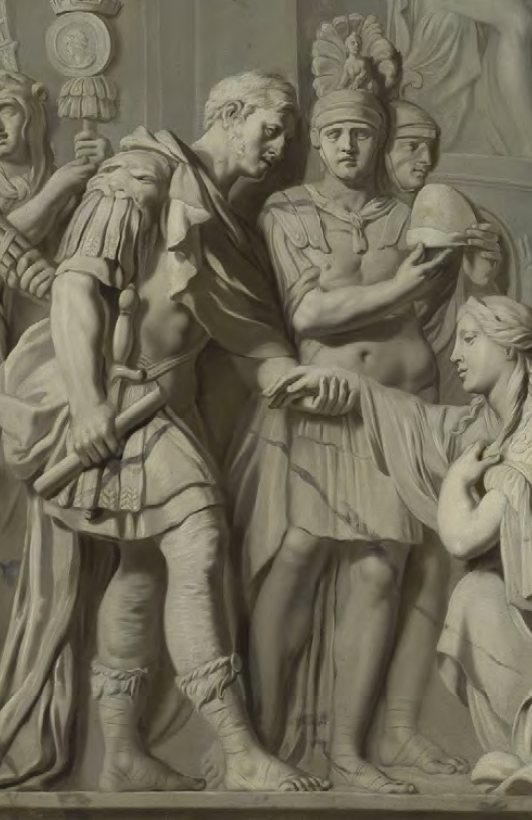
The article is an analysis of an allegorical en grisaille painting attributed to Franciszek Smuglewicz. In the article, I refer to earlier interpretations of the work and present new findings. Throughout its exhibition history, the piece, now listed in the museum inventory under the title Emperor Titus Granting Rights to Rome (1785, MP 3174), was also known as A Reception (Captio) of a Vestal, and since 2017 as The Captio of Rhea Silvia. However, the iconographic model for the main scene is the reverse legend on a Roman coin minted during the reign of Emperor Vespasian with a depiction of Roma resurge[n]s (c.71 A.D.). Therefore, I propose the tentative title Allegory of Rome Raised from its Fall by Emperor Vespasian. Furthermore, the existence of a drawing which is a template for this composition, attributed to the Dutch artist Gérard de Lairesse (1641–1711) or his workshop, discovered in past catalogues of two British auction houses, casts doubt on the traditional attribution of the painting.
Bibliografia
Baliszewski Mikołaj, ‘Polski artysta w „tempio del vero gusto”. Uwagi do rzymskiej biografii Franciszka Smuglewicza’, Biuletyn Historii Sztuki, no. 4 (2017), pp. 705–775.
Hillegers Jasper, ‘The Drawings of Gérard de Lairesse: State of Affairs’, Journal of Historians of Netherlandish Art, vol. 12, no. 1 (2020), DOI: https://do.org/10.5092/jhna.2020.12.1.5, https://jhna. org/articles/the-drawings-of-gerard-de-lairesse/ [retrieved: 28 Nov. 2024].
Li Weixuan, ‘The Hands Behind Lairesse’s Masterpieces: Gerard de Lairesse’s Workshop Practice’, Journal of Historians of Netherlandish Art, vol. 12, no. 1 (2020), DOI: https://doi.org/10.5092/jhna.2020.12.1.4.
Roy Alain, Gérard de Lairesse (1640–1711) (Paris, 1992).
Ruszczycówna Janina, ‘Konstytucja 3 maja 1791 r. w grafice XVIII wieku’, Biuletyn Historii Sztuki, no. 2 (1955), pp. 234–248, DOI: https://doi.org/10.11588/diglit.38030#0203. Splendor i wiedza. Biblioteka Królewska Stanisława Augusta. Eseje, eds Alina Dzięcioł, Tomasz Jakubowski (Warsaw, 2022).
Ścigała Judyta, ‘Roma renascens i Roma resurgens w ikonografii monet Galby, Witeliusza i Wespazjana’, Wieki Stare i Nowe, vol. 13 (2018), pp. 20–32, DOI: https://doi.org/10.31261/WSN.2018.18.02.
C. Suetonius Tranquillus, The Lives of the Twelve Caesars, tr. J.C. Rolfe, Loeb Classical Library (London, 1914), http://penelope.uchicago.edu/Thayer/E/Roman/Texts/ Suetonius/12Caesars/ [retrieved: 3 Nov. 2025].
Titus Livius (Livy), The History of Rome, Book 1, C. 3, tr. Benjamin Oliver Foster (Cambridge, 1919), https://www.perseus.tufts.edu/hopper/ text?doc=Perseus%3Atext%3A1999.02.0151%3Abook%3D1%3Achapter%3D3 [retrieved: 4 Nov. 2025].
W kręgu wileńskiego klasycyzmu, eds Elżbieta Charazińska, Ryszard Bobrow, exh. cat., The National Museum in Warsaw (Warsaw, 2000).
Žakula Tijana, ‘Reforming Dutch art: Gerard de Lairesse on beauty, morals and class’, Simiolus (Special Edition), vol. 37 (2013–2014), DOI: https://doi.org/10.2307/3780455, https://www.jstor.org/stable/44794842.

Utwór dostępny jest na licencji Creative Commons Uznanie autorstwa 4.0 Międzynarodowe.
Prawa autorskie (c) 2026 Karolina Prymlewicz