

Słowa kluczowe
Albrecht Dürer
The Penance of St John Chrysostom
artist rivalry
laudation formulae
Frederick III the Wise
Der Heiligen Leben
Christoph II Scheurl
Kategorie
Jak cytować
Abstrakt
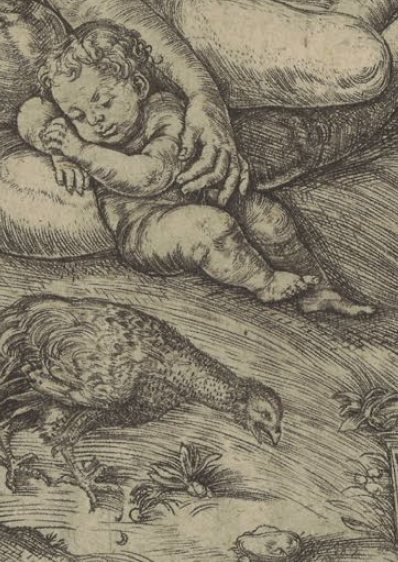
The Penance of St John Chrysostom (H. 1) is a unique work among the prints executed by Lucas Cranach the Elder. The article presents an interpretation of the piece as a showcase of Cranach’s artistic prowess, alluding to the origins and function of his art, as well as to the challenges he set for himself. The work was inspired by Albrecht Dürer’s engraving from c.1496 (H. 54) depicting a surprising interpretation of a legend included in Der Heiligen Leben, a work written around 1400 by the Dominican monks of Nuremberg. Cranach’s Penance of St John Chrysostom proves that the artist understood Dürer’s concept, while also introducing significant modifications. He added animals, the choice of which evokes associations with hunting and court menageries. The impulse to engage in such an artistic competition with Dürer’s works may have come from the words of praise that Cranach was receiving from the German humanist milieu. Comparisons between the two artists were a frequent motif in such texts, the most noteworthy of which is the eulogy by Christoph II Scheurl (1481–1542). By alluding to the ‘courtly dimension’ of his art, highly valued at the time, Cranach created a work that was a visual manifesto of his artistic potential and position at the Wittenberg court.
Bibliografia
Albrecht Dürer, ed. Christof Metzger, exh. cat., Albertina (Vienna, 2019).
Albrecht Dürer. Das druckgraphische Werk, vol. 1, Kupferstiche, Eisenradierungen und Kaltnadelblätter, eds Rainer Schoch, Matthias Mende, Anna Scherbaum (Munich, 2001).
Bacon Paul M., ‘Art Patronage and Piety in Electoral Saxony: Frederick the Wise Promotes the Veneration of His Patron, St Bartholomew’, The Sixteenth Century Journal, Ann. 39, no. 4 (2008), pp. 973–1001.
Bacon Paul M., ‘Humanism in Wittenberg: Frederick the Wise, Konrad Celtis, and Albrecht Dürer’s 1508 “Martyrdom of the Ten Thousand Christians”’, Konsthistorisk tidskrift / Journal of Art History, no. 82 (1) (2013), pp. 1–25.
Bartrum Giulia, German Renaissance Prints 1490–1550, exh. cat., British Museum (London, 1995).
Bierende Edgar, Lucas Cranach d.Ä. und der deutsche Humanismus. Tafelmalerei im Kontext von Rhetorik, Chroniken und Fürstenspiegeln (Munich, 2002).
Bonnet Anne-Marie, ‘Der schnellste Maler der deutschen Renaissance. Positionen der Cranach-Forschung’ in Bild und Bekenntnis. Die Cranach-Werkstatt in Weimar, eds Franziska Bomski, Hellmut Th. Seemann, Thorsten Valk (Göttingen, 2015), pp. 207–226.
Cárdenas Livia, The Texture of Images. The Relic Book in Late-Medieval Religiosity and Early Modern Aesthetics (Leiden, 2020).
Cranach, ed. Bodo Brinkmann, exh. cat., Städel Museum, Frankfurt am Mein; Royal Academy of Arts (London, 2007).
Cranach. Die Anfänge in Wien, eds Guido Messling, Kerstin Richter, exh. cat., Winterthur, Kunsthistorisches Museum, Vienna (Munich, 2022).
The Early Dürer, eds Daniel Hess, Thomas Eser, exh. cat., Germanisches Nationalmuseum (Nuremberg, 2012).
Emperor Maximilian I and the Age of Dürer, eds Eva Michel, Maria Luise Sternath, exh. cat., Albertina, Vienna (Munich, 2012).
Gnann Achim, In Farbe! Clair-obscur-Holzschnitte der Renaissance. Meisterwerke aus der Sammlung Georg Baselitz und der Albertina in Wien, exh. cat., Albertina (Vienna, 2013).
Grebe Anja, Dürer. Die Geschichte seines Ruhms (Petersberg, 2013).
Der Heiligen Leben, vol. 2, Der Winterteil, eds Margit Brand, Bettina Jung, Werner Williams- Krapp, Wiliams-Krapp (Tübingen, 2004). Texte une Textgeschichte, 51.
Jurkowlaniec Grażyna, ‘Faith, Paragone and Commemoration in Dürer’s “Christomorphic” Self-Portrait of 1500’, in Faith and Fantasy in the Renaissance: Texts, Images, and Religious Practices, eds Olga Zorzi Pugliese, Ethan Matt Kavaler (Toronto, 2009), pp. 209–228.
Landau David, Parshall Peter, The Renaissance Print 1470–1550 (London, 1994).
Marx Harald, ‘Cranach und Dürer. Zur Bildnisfrage bei Cranachs Katharinenaltar von 1506’, Dresdener Kunstblätter, no. 41 (1) (1997), pp. 11–24.
Münch Birgit Ulrike, ‘Danteske Landschaften als visionärer Ort des Glaubenskriegs: Bellini, Carpaccio, Mantegna und Dürers “Marter der Zehntausend Christen”’, in Orts-Wechsel. Reale, imaginierte und virtuelle Wissensräume, eds Ulrich Port, Martin Przybilski (Wiesbaden, 2013), pp. 62–72.
Oratio doctoris Scheurli attingens litterarum prestantiam, nec non laudem ecclesiae collegiatae Vittenburgensis, ed. Martin Landsberg (Leipzig, 1509).
Sandner Ingo, Heydenreich Gunnar, Cranach als Zeichner auf dem Malgrund – Auswertung der Untersuchungen im infraroten Strahlenbereich. Teil 1: Die Jahre um 1500 bis 1512,
https://lucascranach.org/download/news_22-3-2013.pdf [retrieved: 30 Dec. 2024].
Savage Elizabeth, Early Colour Printing. German Renaissance Woodcuts at the British Museum (London, 2021).
Schmitt Lothar, ‘Farbe, Gold und Teig. Druckgraphische Experimente im 15. und 16. Jahrhundert’, in Chiaroscuro als ästhetisches Prinzip. Kunst und Theorie des Helldunkels 1300–1550, ed. Claudia Lehmann et al. (Berlin, 2018), pp. 241–262.
Strehle Jutta, Kunz Armin, Druckgraphiken Lucas Cranach d.Ä. Im Dienst von Macht und Glauben, exh. cat., Lutherhalle (Wittenberg, 1998).
Temptation in Eden. Lucas Cranach’s ‘Adam and Eve’, ed. Caroline Campbell, exh. cat., Courtauld Institute Art Gallery (London, 2007).
The Wild Man: Medieval Myth and Symbolism, ed. Timothy Husband, exh. cat., Metropolitan Museum of Art (New York, 1980).
Williams-Krapp Werner, Die deutschen und niederländischen Legendare des Mittelalters. Studien zu ihrer Überlieferungs-, Text- und Wirkungsgeschichte (Tübingen, 1986). Texte und Textgeschichte, 20.

Utwór dostępny jest na licencji Creative Commons Uznanie autorstwa 4.0 Międzynarodowe.
Prawa autorskie (c) 2026 Joanna Sikorska